


Printing hologram stickers is more difficult than printing ordinary stickers. If not set up correctly, you will often encounter poor ink adhesion, heavy glare, and color shift between batches. To produce high-quality holographic stickers, you need to understand the entire printing process. Next, I’ll explain how hologram stickers are printed and how to choose suitable materials and printing methods.
What Are Hologram Stickers?

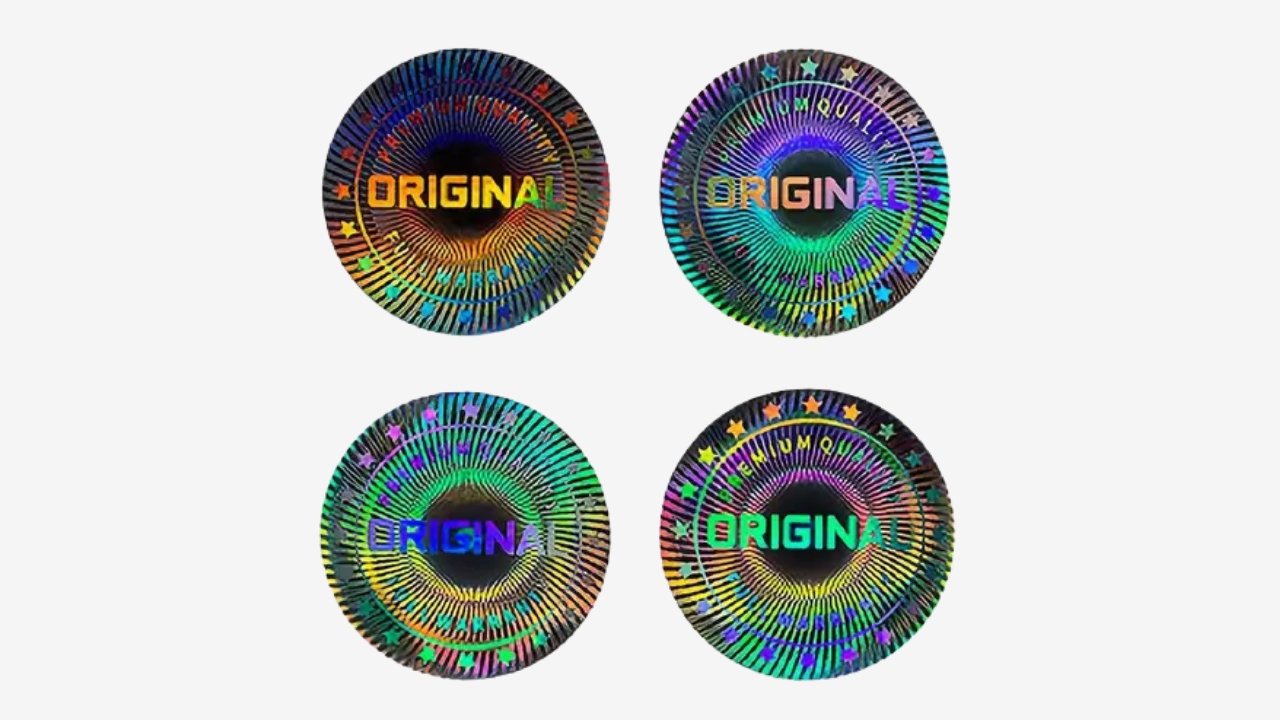
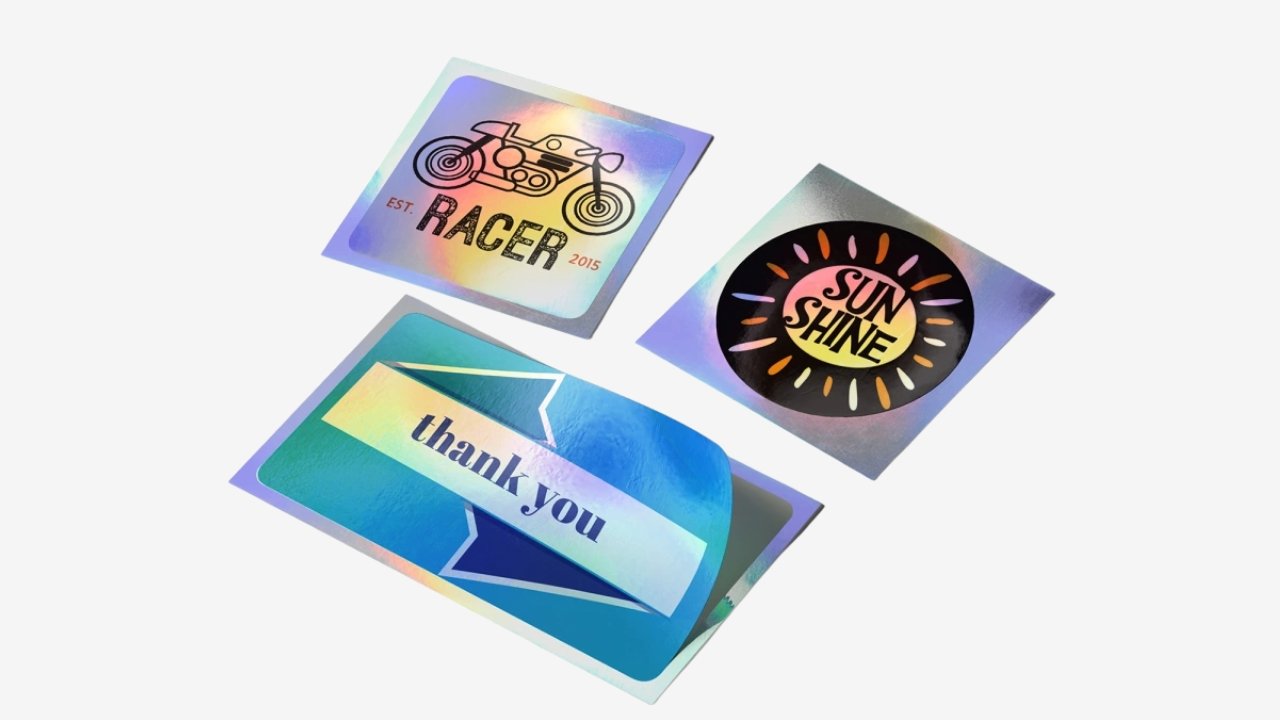
Holographic stickers are self-adhesive labels made from a special laser-diffractive film that produces a kind of rainbow iridescence when exposed to light. Holographic effects come in a variety of forms, including full-coverage holographic backgrounds, localized dot holograms, and pre-made textured patterns.
Printing Methods for Hologram Stickers

UV Printing
UV printing is widely used for custom hologram stickers. Because many holographic films have smooth surfaces, ink adhesion may be poor without suitable surface treatment. With UV printing, a white undercoat is applied first, followed by the CMYK design. Meanwhile, this printing method does not require plate making. It is a good choice if you want to customize small batches of hologram stickers.
Offset Printing
Offset printing is suitable for high-volume hologram sticker orders. It requires printing plates to be prepared before production. Offset printing gives you excellent color consistency in large-volume orders. However, pattern-making increases costs and lengthens production cycles.
Screen Printing
The ink for screen printing is thick, has strong hiding power, and has strong adhesion on the holographic film. If your sticker includes large solid-color areas, bold graphics, or requires high ink coverage, you can choose screen printing for your hologram stickers.
Hologram Sticker Printing Methods Compared

| Items | UV Printing | Offset Printing | Screen Printing |
| Typical Order Volume | Small to medium batches | Medium to large batches | Small to medium batches |
| MOQ | Negotiable | Negotiable | Negotiable |
| Plate Cost | No plate required | Plate-making cost applies | Screen setup cost applies |
| Best For | Detailed graphics, multiple designs, variable data | Large-volume orders with consistent colors | Large solid-color areas |
| Advantage | Fast setup | Lower unit cost at high volumes | High ink coverage and strong opacity |
| Limitation | Higher unit cost for large orders | Higher setup cost and longer preparation | Higher setup cost when using multiple colors |
How to Print Hologram Stickers

Choose the Holographic Material
You can choose a suitable hologram substrate for your project. Our main holographic substrates are PET, PVC, and BOPP, etc.
- PET is suitable for most commercial hologram stickers.
- PVC is more flexible than PET and can conform to curved surfaces. However, it has poor heat resistance and is not suitable for high-temperature environments.
- BOPP is lightweight and relatively cost-effective, so it is a good option for high-volume hologram labels.
Prepare the Artwork
For best results, prepare the hologram sticker artwork as a vector PDF in CMYK mode, with the required bleed and safe area set in advance. Try to avoid using isolated graphic elements in your artwork. Small standalone designs may not stand out clearly against a holographic background, which can affect the overall appearance of the finished sticker.
Print on the Holographic Material
Before production, the holographic film will be pre-treated according to the selected printing process. Most holographic films have a smooth surface, so the printing ink and curing process should match the substrate. In the UV digital printing process, a layer of white ink can be printed over areas of the CMYK design to enhance the design’s opacity, so your stickers will be more colorful.
Add Holographic or Foil Effects
If you want to add a metallic look or a holographic effect to your stickers, you can apply hot or cold foil stamping to specific areas. This process can combine the graphics with gold, silver, and colored foil to create a distinctive finish. This spot foil stamping is a good choice when you want logos or design elements to stand out.
Apply Lamination or Coating
After printing and the foil is finished, you can add a protective finish to improve the sticker’s durability. You can choose from scratch-resistant lamination, matte, glossy lamination, or UV coating. This protective film can protect the sticker and improve the wear resistance of the sticker. A matte finish can also reduce reflections from the holographic substrate when readability is important.
Die Cut and Finish
The final step is die cutting, corner rounding, and waste removal. This gives the finished stickers clean edges and consistent dimensions. Once all processing is complete, we will conduct a random visual inspection, verify the placement of the designs, and check for surface defects.
Custom Hologram Sticker Options

| Specification | Available Choices |
| Size & Shape | Custom sizes, standard shapes, rounded corners, and custom die-cut shapes |
| Holographic Film | PET, PVC, and BOPP with different holographic patterns |
| Holographic Effects | Rainbow, metallic, laser, star, geometric, and custom holographic effects |
| Color & Printing | CMYK, white ink, transparent areas, and selective printing |
| Surface Finish | Glossy, matte, textured, metallic, and 3D tactile effects |
| Adhesive | Permanent, removable, and substrate-specific adhesive options |
| Cutting & Format | Individual stickers, sheets, rolls, and custom die-cutting |
| Security Features | QR codes, serial numbers, microtext, variable data, and anti-counterfeit effects |
How to Control Hologram Sticker Quality
Common Printing Problems
| Production Challenge | Root Cause | Manufacturing Solution | Result |
| Weak Ink Adhesion | Low surface energy or poor surface treatment on holographic film | Use suitable printing-grade film, optimize surface treatment, and control UV curing | Better ink adhesion and scratch resistance |
| Dull or Inconsistent Colors | Strong holographic reflection affects color reproduction | Apply a white ink base and adjust ink coverage according to the film | Brighter colors and clearer graphics |
| Excessive Glare | Holographic patterns interfere with printed graphics | Control white ink coverage and select a suitable matte or glossy finish | Better readability and visual balance |
| Color Variation Between Batches | Differences in film batches and printing parameters | Use consistent film materials and lock key printing parameters after sample approval | More consistent color across production batches |
| Artwork Misalignment | Film movement or dimensional changes during multi-layer printing | Control material tension and registration throughout the printing process | Accurate alignment between print layers |
| Foil or Special-Effect Defects | Incorrect temperature, pressure, speed, or ink thickness | Test and adjust finishing parameters before mass production | Cleaner foil edges and more consistent special effects |
| Bubbles or Wrinkles | Moisture, unstable humidity, or incorrect lamination tension | Control material storage, workshop conditions, and lamination tension | Smoother sticker surfaces and fewer defects |
| High Defect Rate | Small printing or finishing defects become more visible on reflective surfaces | Conduct pre-production sampling and in-process quality checks | Lower rejection rates and more consistent finished stickers |
Quality Control

- Incoming material control: Before entering storage, fully inspect the holographic substrate to check its thickness, surface tension, and appearance.
- Prepress Review: Check your design manuscript and the alignment between the printed artwork and the holographic pattern.
- Printing Process Control: Color accuracy is monitored using a spectrophotometer. The monitoring system monitors whether the holographic area is accurately aligned with the underlying pattern.
- Mechanical and manual inspection: After the finished product is screened by automatic optical inspection equipment, the appearance is manually reviewed to check the pattern position and the integrity of the hot foil. The shipment can only be made after the color is confirmed to be correct by the control sample.
FAQ
What Are Hologram Stickers Commonly Used For?
The applications of holographic stickers can be divided into two categories: one is for brand decoration, and the other is for anti-counterfeiting. When used for decoration, holographic stickers are often applied to cosmetics, wine bottles, and high-end gift boxes to enhance the product’s perceived value. Due to their unique visual effects, hologram stickers can be used as part of an anti-counterfeiting system.
Are Hologram Stickers Waterproof and UV Resistant?
Water resistance and UV resistance depend on the film material, ink, adhesive, and surface protection process. Some holographic stickers can withstand normal contact with water. However, hologram stickers should not be submerged in water for extended periods. If you want to make your hologram stickers more durable, we recommend applying a protective film over them. Standard hologram stickers are likely to fade when exposed to sunlight for extended periods. If the hologram sticker will be used outdoors for a long time, we recommend applying a UV-protective coating to it.
What Factors Affect the Cost of Hologram Stickers?
The price of hologram stickers depends on several factors, including the substrate material, holographic effect, size, and printing process. Usually, there are price differences among substrates like PET, PVC, and BOPP. High-quality holographic film costs more than standard film. Generic holographic patterns are less expensive than custom-designed grating patterns. If you require a white ink undercoat or full-color printing, the cost may be higher. However, we offer free pre-press evaluations and tiered pricing. The larger your order volume, the lower the unit price of the hologram stickers.
Can I Get a Sample Before Placing a Bulk Order?
Yes, we support samples before a high-volume order. Our samples are divided into two types: one is a universal reference sample, and the other is a customized sample. In-stock samples can be shipped quickly, so you can check the material and holographic effect before placing an order. Custom samples are made from your artwork, so you can check the color and texture before placing a bulk order.
How Should Artwork Be Prepared for White Ink and Holographic Foil Separation?
If you need to make both white ink and holographic hot foil, you only need to provide a vector file in AI or CDR format and mark which areas require white ink and which areas require hot foil in the file. If you prefer to set up the layers in the artwork, please place the white ink, color, and foil layers separately in a single file and send it to us.
Final Thoughts

Hologram stickers add a distinctive visual effect to brand packaging and can also support product authentication. Achieving the desired result requires strict quality control. If you’re looking for a reliable supplier of hologram stickers, LIYANTIAN is your best partner. We have years of experience in hologram sticker printing and handle every step of the printing process in-house. Feel free to contact us anytime if you need our services.

