


During the production and storage of chemical products, GHS labels, which are globally recognized classification labels for chemicals, play an important role in ensuring production safety and compliance. To customize compliant GHS labels, it is vital to understand some requirements. In this article, I will introduce these requirements and help you achieve compliance.
What Is a GHS Label?

A GHS label is a hazard warning label developed based on the Globally Harmonized System of Classification and Labelling of Chemicals (GHS). It includes hazard pictograms, signal words, precautionary statements, and product information.
It reminds users of toxic chemical products through eye-catching icons and warning text, and guides them on how to handle the products safely.
GHS Label Requirements

Product Identifier
The product identifier is used to display specific information about a chemical product. On a GHS label, it includes the product name and identification number, helping you quickly recognize the identity of different chemicals. It should be noted that the product identifier on the label cannot be arbitrarily changed. To ensure that the text information is readable, we will place it at the center of the GHS label and avoid any logo covering this information.
Compliant product labels can help you avoid incorrect use of chemical products and reduce the possibility of safety accidents.
GHS Pictograms
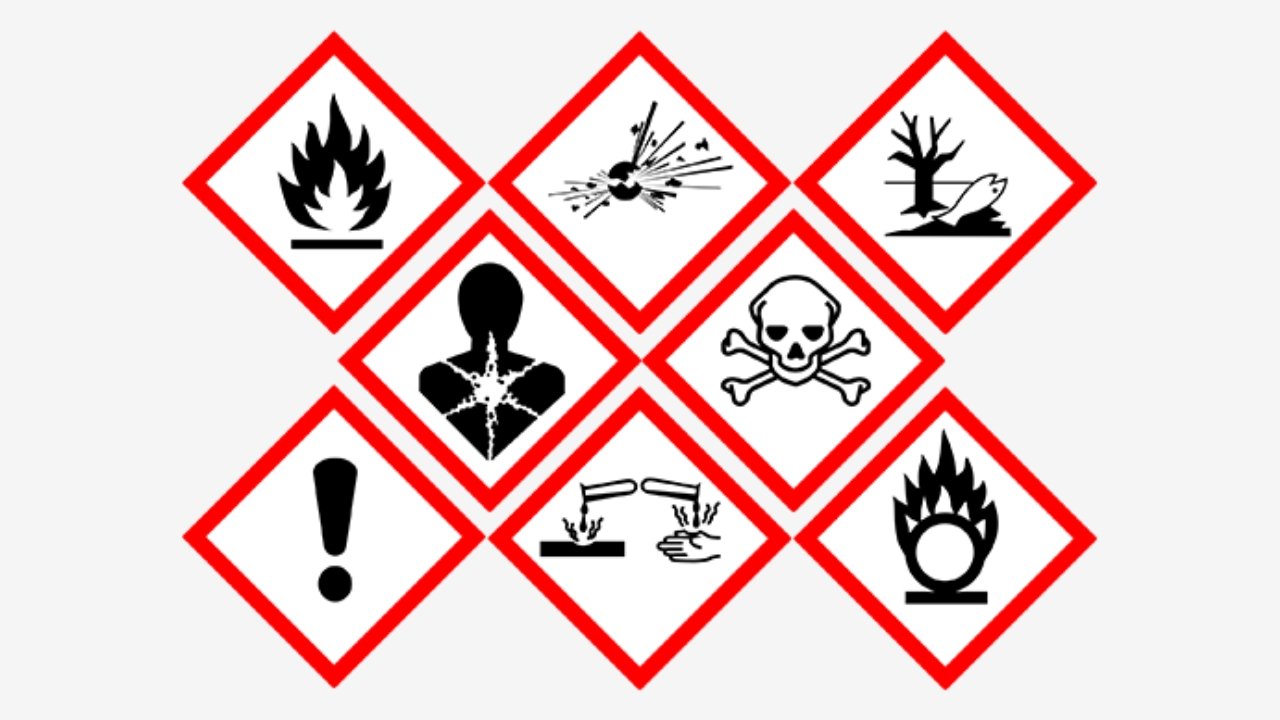
The GHS pictograms use eye-catching patterns to alert you to the potential dangers of chemical products. To enable you to identify the danger at a glance without reading a large amount of text, we will do two things: first, use high-contrast colors to make the symbols more visible; second, accurately assign hazard categories based on the information from the Safety Data Sheet (SDS).
Common GHS pictograms are divided into the following three categories.
Health Hazards
- Skull and Crossbones: This pictogram is used to indicate highly toxic chemical products, which may pose a serious threat to human life and safety.
- Exclamation Mark: The exclamation mark is used to alert you that there are irritating chemical products. They are mildly toxic but are not fatal.
Physical Hazards
- Flame: The flame pictogram is used to indicate flammable or self-igniting substances.
- Oxidizer: This pictogram is used to alert you to oxidizing chemical products, which have a combustion-supporting effect.
- Exploding Bomb: Chemical products with this pictogram may explode, so they should be kept away from heat and open flames.
- Corrosion: The corrosion pictogram indicates that the chemical product is corrosive. You should avoid direct contact with it, as it may damage your skin or eyes.
- Gas Cylinder: This pictogram is used to display chemical products containing pressurized gas. Products with this symbol should be handled carefully.
Environmental Hazards
Environmental hazard pictograms usually feature a dead tree and a fish symbol to warn that these chemical products may cause water pollution to aquatic environments.
Signal Words
Signal words on GHS labels are used to indicate the level of hazard of chemical products. The GHS label has only two signal words: Danger and Warning. A GHS label on a product can only use one warning word. When designing the label, the warning word is usually placed near the top of the label, and below the product name. At the same time, the font size of the warning word must be large and conspicuous enough to attract attention.
Whether to use “Danger” or “Warning” depends on the hazard level of the chemical product. “Danger” is typically used for products with a higher hazard level, while “Warning” is used for products with a lower hazard level. Additionally, these two signal words must be in the correct language of the target market country; otherwise, they will not pass the review.
Precautionary Statements
Precautionary Statements are safety instructions for chemical products. They will tell you how to use, store, and handle the chemical products. These statements are standardized phrases beginning with “P” and are divided into four categories: prevention, response, storage, and disposal.
- Prevention Statements: Teach you how to avoid dangers during the production or transportation of products.
- Response Statements: Guide you on how to handle emergencies correctly to protect yourself.
- Storage and Disposal Statements: Teach you how to store chemical products and dispose of waste products properly, thus ensuring your safety during production, transportation, and handling.
How to Ensure the Safety and Compliance of GHS Labels

Use Durable Materials
Most chemical products are corrosive. If ordinary label materials are used, the text on them can easily fade, making important product information illegible and causing the product to fail compliance review. We recommend using PET labels or PP synthetic labels. Among them, PET labels are waterproof and corrosion-resistant, while PP synthetic labels are soft and are suitable for attaching to curved objects.
To extend the service life of GHS labels, you can choose to laminate the labels to protect them from chemical corrosion. In addition, since most chemical containers have rough surfaces, GHS labels may easily curl or peel off. Therefore, when customizing GHS labels, we recommend using permanent adhesive to make them more durable.
Choose the Suitable Size
All information on the GHS label must be visible. You need to choose the appropriate label size for your products. In general, the larger the product, the larger the label should be.
However, if a chemical product needs to display a large amount of important information, or if it is exported to multiple countries and requires multilingual labeling, we recommend using a larger size to ensure the information is complete and easy to read.
Comply with the Regional Regulations
Each country has its own requirements for GHS labels, so you need to adjust your label design according to the target market. If your products are exported to other countries, localization is also required. This includes not only using the official language of the destination country, but also complying with local regulations.
Before customizing GHS labels, you should verify that the product information is accurate based on the Safety Data Sheet (SDS), and then proceed with the design accordingly.
FAQ
Which Products Must Use GHS Labels?
All hazardous chemical products need to use GHS labels, such as flammable or explosive products, toxic products, corrosive products, etc. Common examples include strong acids, strong alkalis, paints, pesticides, gasoline, and herbicides. To determine whether your product is a hazardous chemical, you can verify the relevant standards by referring to the SDS (Safety Data Sheet).
What Are the Differences Between “Danger” and “Warning” on the GHS Label?
These two signal words represent different hazard levels of chemical products. “Danger” indicates the most severe hazard level, meaning that the chemical product will cause irreversible harm. The hazard level of “Warning” is relatively low. Only one signal word can be used on each GHS label. If the hazard level of your chemical product is extremely low, you can omit signal words.
Can I Design My Own Pictograms?
No. The pictograms on GHS labels are officially standardized, and you must use the specified nine symbols without changing their shapes or colors. The authorities have explicitly stated: GHS pictograms should use black symbols, a white background, and a red border. Any custom pictograms do not comply with the regulations and will not pass the review.
Can a GHS Label Be Designed in Multiple Languages?
Yes. If your products are exported to multiple countries, you may need to customize multilingual GHS labels. Moreover, these languages must be the local official languages. The product information in different languages must be the same and clearly legible. Therefore, when you design GHS labels, you must adopt an appropriate layout and correct format.
How Long Does the GHS Label Last?
The GHS label does not have a fixed lifespan. To ensure its effectiveness, if the label becomes faded or falls off, you should replace it promptly. Additionally, it is important to check whether the GHS label complies with current regulations. If it does not, the label should be replaced.
Can GHS Labels Be Used Outdoors?
GHS labels can be used outdoors. To make it more durable, it should be waterproof and UV-resistant. Meanwhile, it is best to choose PET or PP synthetic labels and apply a protective lamination layer. Only in this way can the text information on the GHS label be visible during use.
Final Thoughts

A compliant GHS label ensures the safety of the product during transportation and storage. Therefore, you need a reliable partner to customize your GHS labels, and LIYANTIAN is your best choice. We have extensive experience in GHS label customization. If you have any needs, please feel free to contact us.

