


The maximum fine OSHA can issue to a warehouse each year is $16,131—missing safety signs are the most common violation. Properly posted safety signs can reduce workplace accidents by 30% to 60%. This guide walks you through the types of warehouse safety signs and labels, OSHA/ANSI requirements, and how to customize them for your warehouse.
OSHA & ANSI Requirements

OSHA is an American government agency whose rules are legally binding. If you violate them, you will face fines. ANSI is a voluntary standards organization that formulates industry guidelines rather than laws, but it is widely cited by OSHA, and you have to comply with both.
The core OSHA clause is 1910.145, which specifically regulates accident prevention signs and tags. It requires you to post OSHA-compliant warehouse signs in all areas where there is a physical hazard. The three types of signal words are Danger, Warning, and Caution.
ANSI Z535 is a design standard for safety signs, covering colors, symbols, and fonts. Red indicates danger/prohibition, orange is a warning, yellow is a caution, green represents safety/first aid, and blue is a mandatory action. If you change this color system randomly, you’ll be out of compliance.
Types of Warehouse Safety Signs and Labels

Floor Safety Signs & Labels
Floor safety signs and labels are markings posted on the warehouse floor. They are used to prevent people from accidentally entering dangerous areas and physically separate the personnel passage from the forklift traffic.
There are two types: permanent ones (epoxy coatings, floor stickers) and temporary ones (removable warehouse floor marking tape).
Yellow and black zebra warning tape, pedestrian walkway markings, forklift lane arrows, and dock door floor markings are all examples you’ll find in most warehouses.
Hazard & Warning Signs
Common hazard and warning signs include high-voltage warning signs, falling object warning signs, height restriction signs, and noise protection notices.
They are often hung or posted in high-voltage areas, on high shelves, near electrical control boxes, and at the entrances of height-limited areas, to alert people of the danger level in advance.
There are three levels: danger, warning, and caution. You should be careful not to mix the hazard classification with the actual level of danger, as this could lead to OSHA violations.
Chemical & GHS Labels
Chemical and GHS labels are specifically designed for chemical storage areas. GHS is the Globally Harmonized System.
Anyone who doesn’t know the chemical can still read the label and understand the hazard level and how to handle it. Your labels must indicate the corresponding icon from the 10 standard hazard symbols (such as the skull = highly toxic, the flame = flammable), as well as the product name, hazard description, preventive measures, first aid measures, accidental release measures, and supplier information. They must be marked in English for the United States.
Fire Safety Signs
Without fire safety signs, no one knows where the fire equipment is or how to evacuate. Exit signs, fire extinguisher location signs, fire hydrant signs, and fire alarm location signs are all common fire safety signs. They can guide people to evacuate quickly in an emergency.
OSHA requires that there be no blind spots along the evacuation route. Therefore, your exit signs usually need to be made of self-luminous or LED materials so they stay visible even when the lights go out. They should be installed above or on the side of the door, with a height of no less than 2.4 meters.
The key information and colors of your fire safety signs must strictly comply with the standards and cannot be overly customized.
Rack & Aisle Labels
You can’t improve your warehouse picking efficiency, reduce human errors, and make inventory checks easier without rack and aisle labels. They can assist with internal warehouse navigation and inventory management.
Common rack and aisle labels are aisle number labels (A, B, C Zone), shelf level labels, barcode labels for storage locations, and shelf weight capacity labels. These labels are replaced frequently, so material durability is crucial.
Barcode labels are the foundation of modern warehouse WMS systems. Scanning failure directly impacts your efficiency of inventory intake and outbound operations.
You need to install the sign at the top or side of the shelf where it’s easy to spot. Your shelf weight capacity labels must specify uniform load and concentrated load. This is a mandatory requirement by OSHA.
Loading Dock & Forklift Signs
The loading and unloading area has the highest casualty rate among warehouse staff.
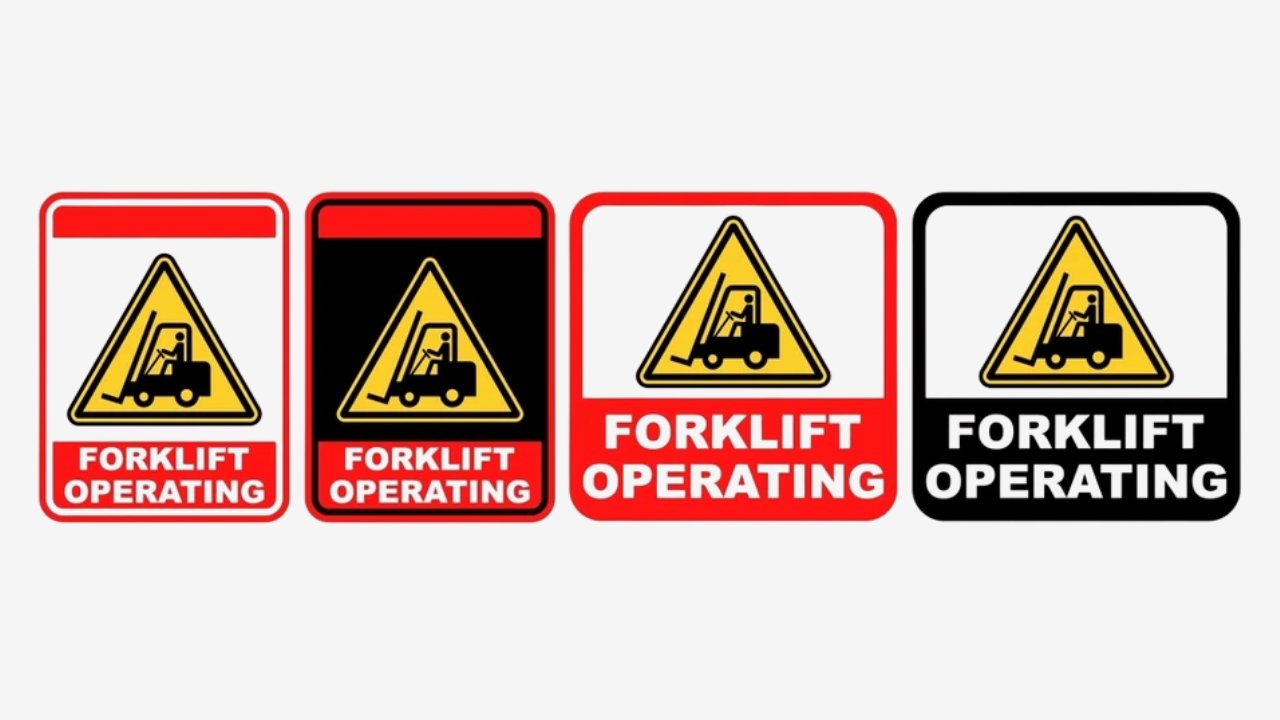
To prevent conflicts between people and vehicles and reduce the accident rate, you should post a higher density of signs than in other areas, such as forklift warning signs, signs prohibiting pedestrians from entering, vehicle waiting lines, and height restriction signs for access gates.
Note that you must not forget to post a convex mirror warning sign at corners where forklifts have blind spots, forklift speed limit, edge guard labels, and pedestrian safety line markings.
Loading dock signs should be resistant to forklift crushing and chemical solvents (such as diesel), rather than ordinary paper labels.
How to Customize Your Warehouse Safety Signs and Labels

Select the Right Material
Here’s a quick breakdown about the materials, features, and applications of the warehouse safety signs and labels:
| Material | Feature | Application | Warehouse type |
| Vinyl | Most common, low cost, easy to cut | Dry indoor environments
| Normal indoor warehouse |
| Polyester | More durable than vinyl, with chemical resistance | Chemical storage areas
| Chemical warehouse |
| Aluminum | Waterproof, rust-resistant, and longest lifespan | Outdoor or heavy industrial environments | outdoor loading and unloading area |
| Rigid Plastic | Lightweight and durable | Signs to be hung | Normal indoor warehouse |
If your warehouse needs to use shelf labels, we recommend choosing removable adhesive for easy replacement. If you are frequently in bright light, you can choose matte labels, which are easier to read.
Follow Size & Color Standards
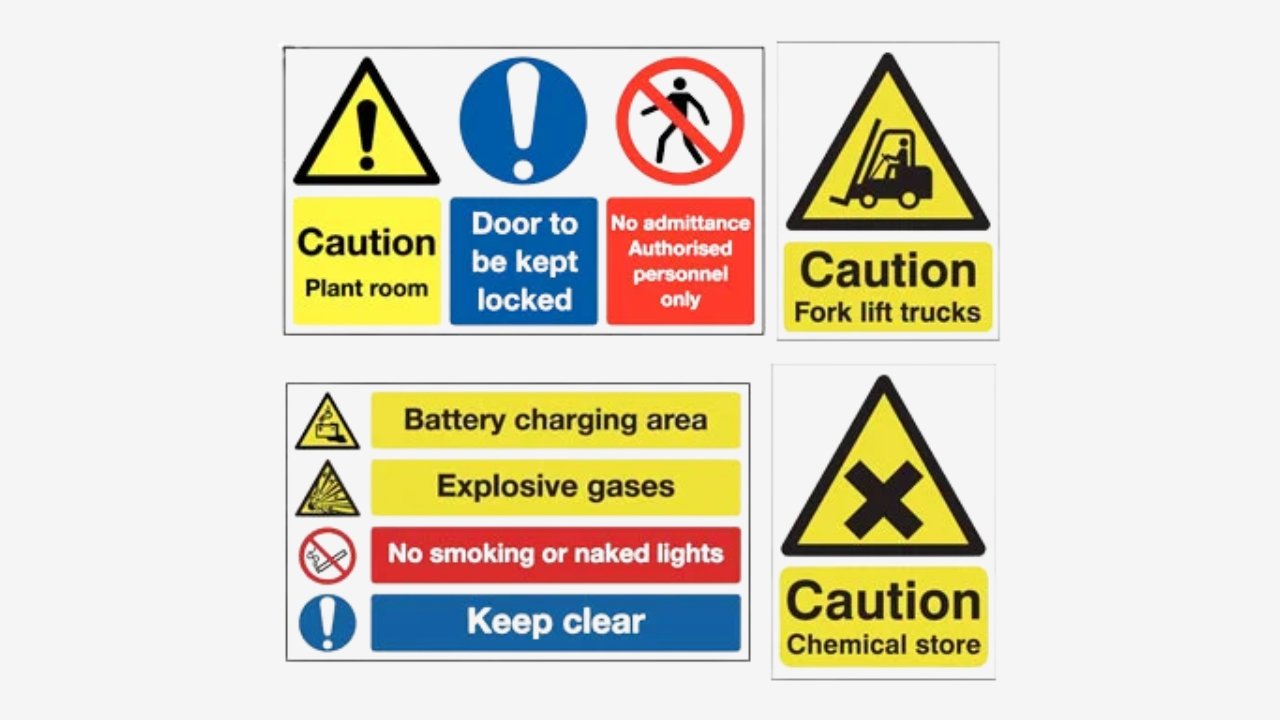
OSHA does not standardize the sizes for signs, but it requires that the labels be clearly visible within the normal working distance. The ANSI recommendation is that for every additional foot of observation distance, the height of the letters increases by 1/25 inch.
We suggest that the main aisle sign in your warehouse be at least 10×14 inches, and the rack labels should be determined according to the storage locations.
When customizing the colors for warehouse labels, keep in mind that the background color and text color must form high contrast. Yellow background with black text, or white background with red text, both work well.
You cannot change the signal color based on the brand color requirements. Instead, you should use the brand color in non-signal areas, such as the company name or logo at the bottom of the sign.
Design Your Label Content
Every warehouse safety sign and label needs four things: signal words, hazard descriptions, precautionary instructions, and symbols. The standard layout recommended by ANSI is to place the icons on the left and the text on the right.
The text on your label should be as brief as possible, use only sans-serif fonts (such as Arial), and avoid decorative fonts.
Your company logo added to the label must not interfere with the readability of the key information. When your warehouse has non-English speaking employees, we recommend creating bilingual safety labels in Spanish or other languages.
You can add a QR code to the safety label that links to operation manuals or safety training videos—a practice that is becoming increasingly common in modern warehouses.
Plan Your Order
Before placing your order, confirm the quantity, size, material, and adhesive type for each label. Also, decide upfront whether you need a sample.
We suggest keeping an extra 10-15% of labels in stock for replacing any damaged ones. When requesting a quote, you can specify the usage environment (indoor/outdoor/chemical zone). The supplier can then recommend suitable materials for you.
Before communicating with the supplier, you need to prepare the relevant design documents in AI or PDF format with a resolution of at least 300 dpi. If there are no design documents, please indicate whether you need the supplier to handle the design.
If this is your first time working with the supplier, we suggest that you place a small trial order first to verify the quality before placing a bulk order for warehouse safety labels.
FAQ
What Is the Difference Between a Warehouse Safety Sign and a Safety Label?
Warehouse safety signs are typically made of rigid materials such as aluminum plates, hard plastics, and acrylic. They are fixed with screws, hooks, and brackets, and can exist independently.
Safety labels are generally made of flexible materials (Vinyl, Polyester), they have adhesive on the back and stick directly onto equipment, shelves, and products.
Safety signs are larger in size and are used for long-distance recognition, while safety labels are smaller and are designed for close reading.
Safety signs stay in one place and rarely need to be moved. Warehouse safety labels, on the other hand, need to be replaced regularly and can be applied to irregular surfaces.
How Often Should Warehouse Safety Signs and Labels Be Replaced?
There is no fixed replacement cycle for warehouse safety signs and labels.
We suggest that you conduct a comprehensive inspection each year alongside your compliance audits. When the layout of your warehouse is adjusted, or the functions of the areas change, the relevant labels must be updated at the same time.
You should keep an eye on OSHA/ANSI updates and check your signs against any new rules. Rigid labels (aluminum, hard plastic) are usually replaced every 3 to 5 years, while flexible labels (vinyl, polyester) are typically replaced every 1 to 2 years.
In high-wear areas like loading zones and forklift aisles, you’ll need to swap them out more often, so you can replace them every 6 to 12 months.
Can Warehouse Safety Labels Be Printed In-House?
Yes, but there are restrictions. Standard safety labels like shelf numbers, aisle labels, and bin labels can be printed by yourself, but please ensure that your colors and fonts comply with ANSI standards.
Ordinary printers can’t hit the right colors, and the ink fades fast. The materials have poor durability—peeling is a real problem. Once you do not comply, you will be held responsible for OSHA violations.
For OSHA/ANSI compliance labels—signal words, GHS labels, and fire safety signs—don’t print them yourself. We recommend that you hand them over to a professional supplier.
What Should I Do if My Warehouse Safety Signs Are Damaged or Faded?
You should replace them immediately. Don’t keep using them. Damaged or faded warehouse safety signs are regarded as missing during OSHA inspections.
While waiting for the new ones, you need to cover the original area with temporary warning tapes or signs to ensure safety. When replacing, check the other signs of the same batch so nothing gets missed.
Remember to record the replacement date and location, and include it in the compliance file.
Are There Specific Labeling Requirements for Cold Storage Warehouses?
No, OSHA/ANSI compliance requirements don’t change based on your warehouse type. Cold storage warehouses also need to post all the necessary signs, but the material requirements are higher.
Cold storage labels need to handle temperatures as low as -40°C, resist condensation, and won’t ice up. Do not block the ventilation openings.
Ordinary vinyl will become brittle, crack, and fall off at low temperatures. The cold storage warehouses must use low-temperature-grade polyester or a specific material for cold storage labels.
Due to the temperature difference in cold storage, the surface of safety signs is prone to condensation, so you must make sure your materials are moisture-proof.
For emergency signs, such as exits and fire exits, add an anti-fog marking to prevent condensation from blurring vision.
Final Thoughts

We manufacture custom warehouse safety signs and labels, ensuring they comply with OSHA/ANSI standards. If you want to customize safety signs and labels for your warehouse in bulk and are looking for a reliable warehouse safety labels supplier, please contact us to get a free quote.

